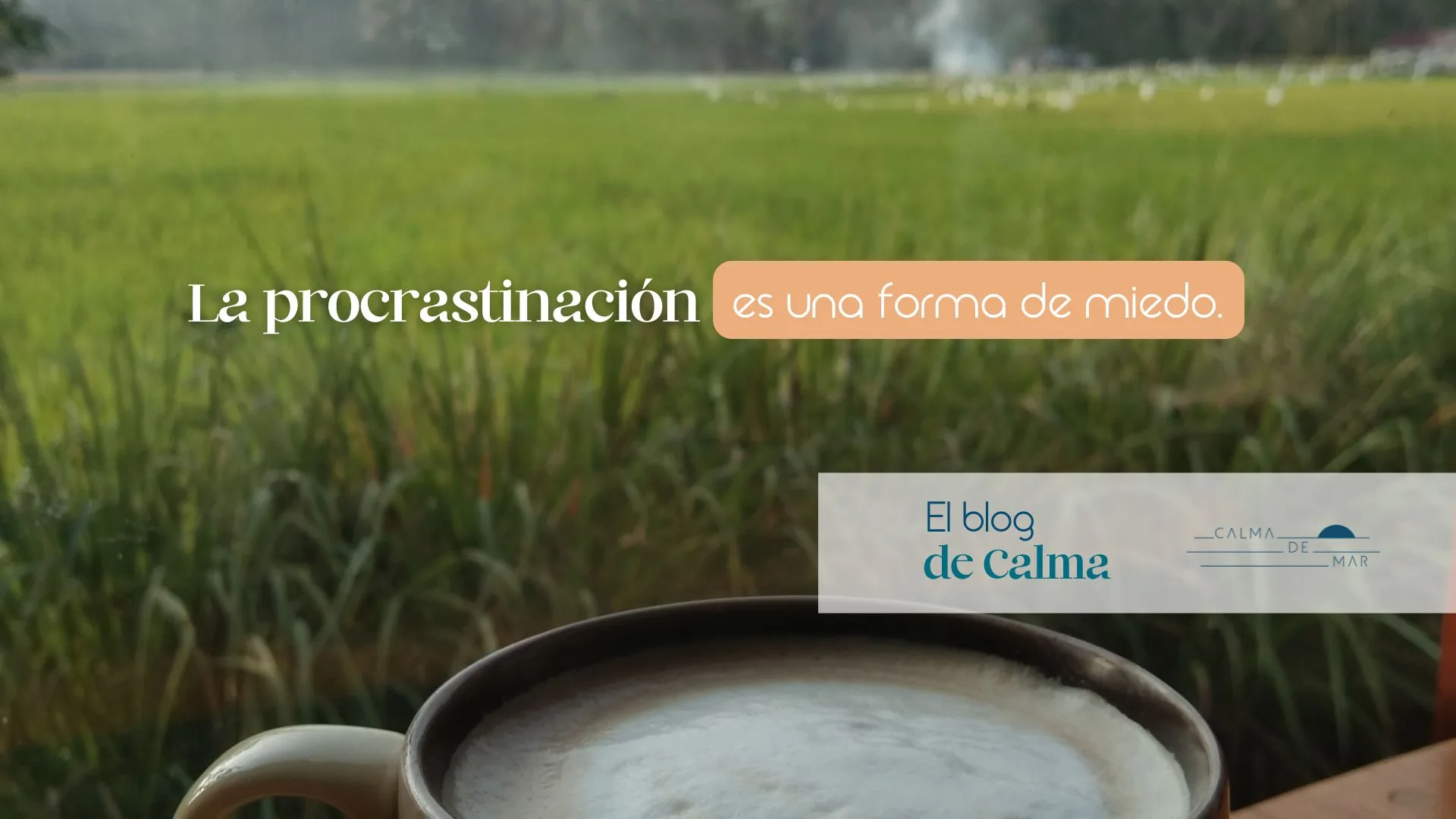
and that fear is hard to admit.
“I can’t be bothered.”
“I’d better start tomorrow.”
“I can’t today.”
Procrastination is usually seen as a lack of discipline or motivation. And when we are the ones putting things off, we often end up telling ourselves exactly the same: that we are lazy, disorganised or incapable of doing what we know we should.
But sometimes what is going on is rather more complex.
Behind a postponed task there can be fear. Fear of getting it wrong. Of not measuring up. Of discovering we are not as capable as we hoped. Of the result not being perfect. Even fear that things will go well and we will then have to live up to new expectations.
In short: procrastinating does not always mean being afraid, and not all procrastination has the same cause. But often putting things off works as a way to avoid, for a while, an uncomfortable emotion linked to what we have to do. Understanding what we are avoiding can be more useful than punishing ourselves for not having started sooner.
Procrastinating is not simply “not doing”
When we procrastinate, we do not usually decide consciously: “I’m going to leave this until the last minute”.
We know the task is pending. We think about it. We promise ourselves we will start later.
And meanwhile we do other things that seem terribly urgent: tidying, answering messages, watching a video or looking up more information “before starting”.
The task is still there, but for a few minutes we feel relief.
That relief matters, because often we are not only avoiding the task. We are avoiding what that task makes us feel.
What fear can lie behind procrastination?
There is no single explanation.
Sometimes it is fear of failure:
“What if I try and I can’t do it?”
Other times, perfectionism:
“If I can’t do it really well, I’d better not start yet.”
There can also be fear of being judged, insecurity or dread of making a decision that has consequences.
We can even delay something we want because getting it would mean more exposure, responsibility or change.
We are not always aware of these fears. That is why it is much easier to say “I can’t be bothered” than to ask ourselves what we feel when we imagine really starting.
The relief of putting things off is short-lived
Avoiding works. At least for a while.
If we have to hand in a piece of work that makes us feel insecure and we decide not to open it this afternoon, the anxiety may drop.
The problem is that the task does not go away.
Tomorrow it is still pending, but now there is less time. Guilt may appear for not having made progress, the pressure rises and the task starts to look even harder.
Then a circle forms:
the task worries me → I avoid it → I feel relief → guilt or pressure appears → the task makes me feel even worse → I avoid it again.
Sometimes we spend more energy thinking about what we are putting off than doing it.
“I’ll do it when I’m ready”
This sentence can sound reasonable.
And sometimes we really do need to rest, ask for help or gather more information.
But at other times “when I’m ready” becomes an impossible condition.
We wait to feel confident before acting. To feel like it. To know exactly how to do it. To be sure it will turn out well.
The problem is that there are things we may never feel completely ready for.
Sending off a project. Having a difficult conversation. Putting ourselves forward for an opportunity. Starting something new.
Sometimes confidence does not come before taking the step. It appears after we find out that we can move forward even with some fear.
When perfectionism disguises itself as procrastination
Perfectionism does not always look like someone working non-stop.
It can also paralyse.
If the standard is too high, starting means facing the possibility of not reaching it. So we look for the perfect moment, the perfect idea or the perfect conditions.
“I’m tired today.”
“I need more hours in a row.”
“First I have to get everything organised.”
Preparing can be necessary. But it can also become a way of not exposing ourselves.
Because as long as we do not finish, no one can judge the result.
Not all procrastination is fear
Although this article comes from the link between procrastination and fear, it is important not to turn it into a universal explanation.
We may put things off because we are exhausted, because the task is unclear or too big, because we have too many demands at once, because we do not know where to start, or because there are difficulties with attention, planning or organisation.
So before asking “what am I afraid of?”, it can help to ask a broader question:
What is making it hard to start this?
The answer may be fear. But it may be tiredness, overload, lack of structure or a mix of several things.
Admitting we are afraid can be hard
Acknowledging fear also takes courage.
It is easier for us to say “I haven’t had time” than to admit:
“I’m afraid of doing it badly.”
“I don’t know if I’ll measure up.”
“I’m embarrassed for people to see what I’ve done.”
Sometimes procrastinating also keeps a fantasy intact: “I could have done it really well if I’d had more time”.
That way we avoid fully facing our limits, but we also stop ourselves from discovering our real abilities.
What is procrastination trying to protect?
Instead of only asking “how do I force myself to do it?”, we can get curious about the function the avoidance is serving.
What does not starting protect me from?
From getting it wrong?
From being seen?
From finding out I can’t do everything?
From disappointing someone?
From disappointing myself?
This is not about endlessly justifying doing nothing.
It is about understanding why a part of us is putting on the brakes.
When we understand that, we can look for a way forward that does not depend only on forcing ourselves.
Making it small can help
When a task triggers a lot of fear or blockage, thinking about finishing the whole thing can make it even more threatening.
We can shrink the next step.
Not “do the presentation”, but open the document.
Not “write the report”, but draft the first paragraph.
Not “look for a job”, but update one section of the CV.
The aim is not to fool ourselves. It is to shorten the distance between being paralysed and getting moving.
A small step also counts.
Doing it scared
There is a phrase I say to my daughter and that I also try to repeat to myself:
we do it scared.
Not because we have to throw ourselves at anything while ignoring our signals.
But because waiting until we never feel fear can keep us still for too long.
We can acknowledge it:
“Yes, this scares me.”
And then ask ourselves:
“What is the smallest step I can take without needing the fear to go away?”
Sometimes moving forward is not about defeating an emotion. It is about no longer demanding that the emotion leave before we allow ourselves to act.
Stop punishing ourselves so we can move
When we have procrastinated for days, it is easy to add a second layer of suffering:
“I always do the same thing.”
“I’m a disaster.”
“I’m never going to change.”
That inner dialogue can increase shame and avoidance even further.
Responsibility is necessary, but responsibility and punishment are not the same thing.
We can acknowledge:
“I’ve been avoiding it.”
“This is hurting me.”
“I need to do something different.”
Without turning it into:
“There’s something wrong with me.”
Curiosity usually gives us more information than contempt.
When is it worth asking for help?
We all put some things off.
But if procrastination seriously interferes with work, studies, relationships, self-care or important decisions, it may be worth exploring what is going on.
Especially if the blockage comes with intense anxiety, perfectionism, fear of judgement, exhaustion or a repeated sense of incapacity.
It may also be important to assess whether there are difficulties with attention, planning or organisation.
We do not always need more discipline.
Sometimes we need to understand the problem better.
How can we support you at Calma de Ser?
In therapy we are not interested in stopping at “you should get more organised”.
We can explore what happens just before you put something off, what thoughts appear, what emotion is triggered and what relief you get when you decide to leave it for later.
We may find fear of failure. Self-demand. Shame. Overload. Difficulty prioritising.
Understanding the pattern lets us work not only on the pending task, but on what turns it into a threat.
The aim is not for you never to procrastinate again.
It is for you to be better able to recognise what is holding you back and choose how you want to respond.
Moving forward does not mean no longer being afraid
Accepting our fears does not mean they automatically disappear.
Nor do we have to “get over them” before starting.
Sometimes transformation happens when we stop running from the discomfort and discover we can do something small even while it is still there.
Maybe today you do not need to finish everything.
Maybe you only need to open the document. Send that message. Write the first sentence. Ask for help.
Or acknowledge:
“It’s not that I don’t want to do it. It’s that a part of me is afraid.”
And from there, begin.
As I say to my daughter and repeat to myself:
we do it scared.