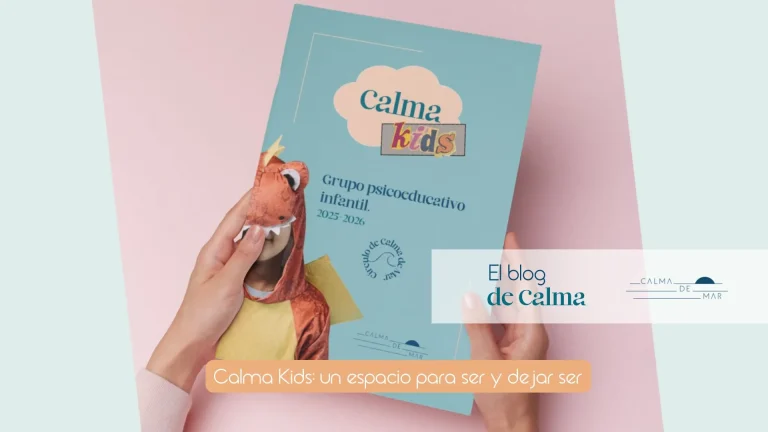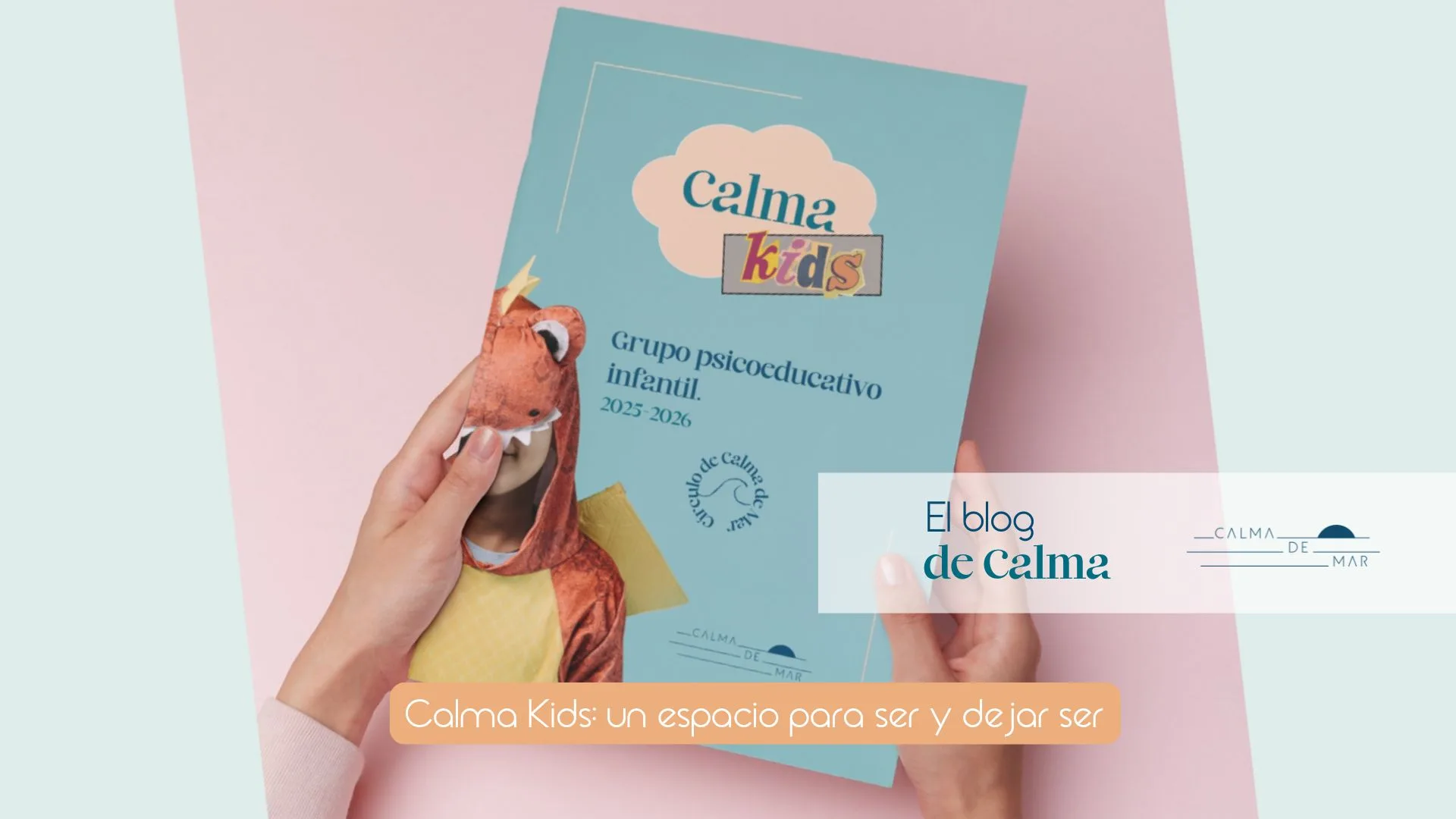
Some projects come into your life as an opportunity, but end up becoming much more than that. That is what Calma Kids was for me.
When my colleagues suggested I lead this group, something moved strongly inside me. I knew it could become a special space: a place where children could meet others, play, express themselves and get to know themselves without feeling they have to do everything right.
Because growing up also needs spaces where there is no need to perform. Spaces where you can try, make mistakes, get angry, laugh, stay silent, share and gradually discover who you are.
And that, for me, is one of the essences of children’s emotional development.
In short: children do not develop their emotional resources only when we explain to them what emotions are. They also do so by playing, relating, setting boundaries, experimenting and feeling safe enough to show themselves as they are. Calma Kids was born with the intention of offering a supported space where all of that can happen while respecting each child’s pace.
Who I am and where this vocation comes from
My name is Berta, I am a child and adolescent psychologist and part of the Calma de Ser team.
I think my vocation for supporting children goes back a long way, although it has taken shape over the years. I am the eldest of seven cousins and, since I was little, I have lived surrounded by games, questions, tantrums, discoveries and imaginary worlds with them.
Later I started working as a babysitter with different children and, over time, child and adolescent psychology became part of my professional life.
That whole journey has let me observe something that still fascinates me: when a child finds a space where they feel safe and not overly directed, many things appear.
Their particular way of looking at the world appears.
Their resources.
Their fears.
Their imagination.
Their needs.
And also their way of relating to others.
Play and children’s emotional development
For an adult, playing may seem simply a pleasant activity or a way to pass the time. For a child, however, play is also one of the natural ways of exploring the world and relating to it.
Through play they rehearse roles, try out solutions, negotiate, get frustrated, imagine, cooperate, compete, set boundaries and discover what happens when someone else wants something different.
That is why, in a space like Calma Kids, we do not see play as a reward after “working on emotions”.
Play is part of the very process of getting to know yourself and relating to others.
It can allow children to be without so many filters or demands, to express themselves in a way other than words and to try out new ways of solving small difficulties.
And there the adult’s support matters: not to constantly direct what happens, but to observe, hold, set boundaries when needed and help translate certain experiences.
A safe space does not mean everything is easy
When we talk about offering children a safe space, we are not talking about avoiding every conflict, frustration or discomfort.
Children also need to meet the “no”, the waiting, the difference, someone who does not want to play the same game, or an activity that does not turn out as they expected.
Safety has more to do with being able to go through those experiences knowing there are available adults who support without ridiculing, frightening or demanding a perfect response.
In those small moments very important things are learned:
“I can get angry and still belong to the group.”
“I can say I don’t like something.”
“I can make mistakes.”
“Other people have boundaries too.”
“I can ask for help.”
“What I feel has a place, but I don’t have to turn everything I feel into an action.”
For me, there is a precious part of emotional support right there.
Learning to recognise emotions, needs and boundaries
One of the things we try to encourage at Calma Kids is for children to gradually build their own language to understand themselves.
Sometimes they will be able to say directly:
“I’m angry.”
“I don’t want to.”
“I felt embarrassed.”
“I wish they had picked me.”
And other times they will not have the words yet.
Perhaps we will see it in play, in a withdrawal, in an argument or in a huge urge to control how an activity is done.
Our job is not to quickly stick an emotional label on them, but to help them ask themselves what is happening and give them resources to recognise it gradually.
Because developing emotional awareness is not learning a list of emotions by heart. It is being able to gradually connect what I feel, what I need, what I do and what happens in my relationships.
The importance of being able to be without doing everything right
Childhood is not spared the culture of demand either.
School, after-school activities, performance, behaviour, comparison, schedules. Sometimes children’s days are as structured as adults’.
And, of course, learning, taking on responsibilities and living with rules is part of growing up.
But we also need to ask ourselves where the spaces are in which there is nothing to prove.
At Calma Kids we especially care about protecting this.
We are not looking for the child who best identifies emotions, participates most or does the activities “correctly”.
We also want to support the child who needs to watch before joining in.
The one who talks a lot.
The one who gets angry when they lose.
The one who needs a little more time.
The one who, one day, does not feel like explaining what is wrong.
Being and letting be does not mean ceasing to support. It means supporting without trying to turn every child into the same child.
Growing up also happens in relation to others
One of the values of the group is precisely that many experiences cannot be rehearsed alone.
Asking to join a game.
Accepting that someone else has a different idea.
Feeling I was not picked.
Saying that something bothers me.
Waiting.
Sharing.
Repairing after an argument.
Discovering that someone can like me as I am.
The group offers a small laboratory of real relationships.
And that makes it possible to support skills related to self-esteem, trust, empathy, communication and boundaries without turning them into a theory lesson.
It is not about preparing children never to have conflicts.
It is about them gradually having more resources to be in them.
What a space like Calma Kids can offer
Each child arrives with their own story, temperament and developmental stage. That is why we do not expect the same process or the same result for everyone.
Calma Kids can be an opportunity to:
- broaden their emotional vocabulary and better recognise what is happening to them;
- discover and express needs and boundaries;
- practise social skills within a supported group;
- strengthen personal resources and a kinder view of themselves;
- experience play, movement and creativity as forms of expression;
- learn to live with small frustrations and differences;
- find a space where they feel seen without having to stand out.
We do not aim to promise specific changes or to turn every behaviour into a psychological problem. We want to create the conditions for each child to explore, relate and grow from a place of greater confidence.
Calma Kids does not replace individual therapy when it is needed
It is also important to tell apart a group space for emotional support from an individual psychotherapy process.
There are times when a child can benefit greatly from sharing and growing within a group. And there are others when a particular difficulty needs a more specific assessment or individual and family support.
That is why, when there are intense or persistent mood changes, anxiety that greatly interferes with daily life, significant behavioural difficulties, major school problems or suffering that worries the family, it is advisable to assess it individually.
It is not about pathologising what is part of growing up, but about being able to offer the most suitable kind of help at each moment.
The essence of Calma Kids
Every session confirms something I already sensed when this project began: Calma Kids has a soul of its own.
A space to share, explore and grow from bonding and trust.
A place to plant small seeds related to self-esteem, self-care and relationships with others.
A space to start discovering that I have a voice, boundaries, needs and resources.
And, above all, a place where we do not need to rush to reach a certain version of ourselves.
We can support the process.
We can observe.
We can play.
We can be there.
We can be and let be.