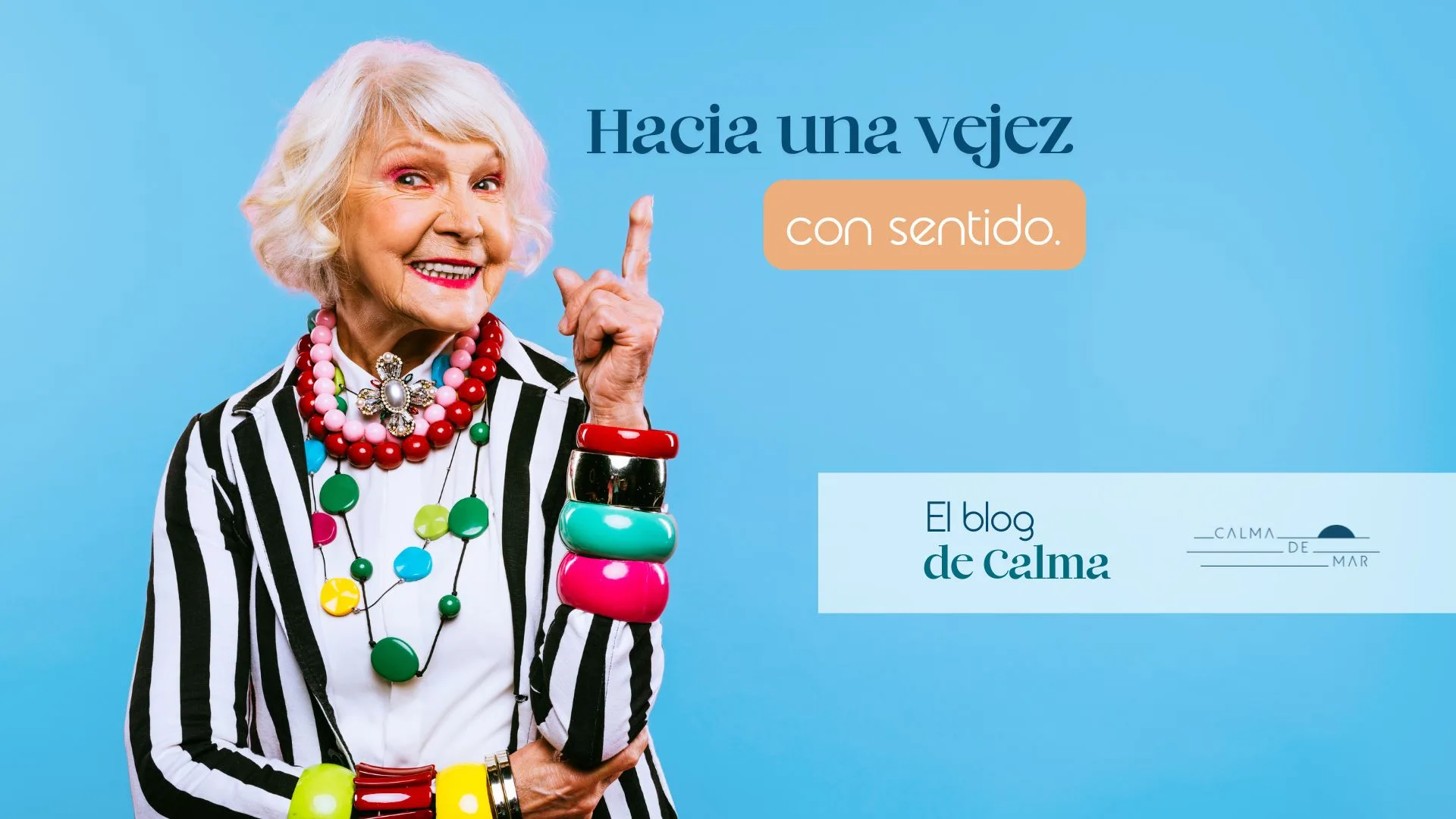
Growing old is part of life and yet we do not always know how to look at this stage without reducing it to losses, limitations or dependence.
I am Laura Peiró Aguarón, registered general health psychologist and psychotherapist, collaborator at Calma de Ser. Alongside my vocation in mental health, a deep passion for art has always accompanied me. From the union of these two parts of me, (S)avis i (B)ells was born: an art project that invites us to reflect on ageing, identity, beauty and the place we give older people in our society.
The project was presented at the Casa de Cultura of El Masnou in November 2024, as part of the Visual Arts programme. But the questions that gave rise to it remain open.
What does it mean to grow old today? What happens to our identity when our social role changes? Do we know how to listen to the experience of those who came before us, or do we speak for them without realising?
In short: talking about ageing is not only talking about decline. It is also talking about identity, belonging, bonds, losses, transformations, memory and meaning in life. (S)avis i (B)ells is born as an invitation to look at old age with more complexity and fewer prejudices.
What does it mean to grow old in the 21st century?
Since I was young I have felt great curiosity about this stage of life, perhaps because my grandparents were very important figures for me.
We live in a society that especially values speed, autonomy, productivity and novelty. From there, growing old can easily become associated with the idea of “ceasing to be”: ceasing to work, to produce or to occupy certain spaces.
But a person does not disappear when they retire.
Nor can their identity be reduced to their age, their diagnoses or the help they need.
Ageing brings real changes and, at times, major losses. But it can also involve new ways of relating to time, to bonds and to what gives one’s life meaning.
So perhaps the question is not only how we age, but also how we as a society look at those who are ageing.
What do we mean when we say “older person”?
We use expressions like “the elderly”, “retiree” or “older person” as if they described a homogeneous group.
But under the same chronological age there can be completely different lives.
Some people go on working, caring, creating, learning or taking an active part in their community. Others go through loss of autonomy or health problems. Some enjoy a solid network of affection and others live in isolation.
Age tells us something, but it does not tell us who that person is.
When we forget this, we can start relating to older people from a preconceived idea of what we think they need, feel or can do.
And there an important issue appears: ageism.
Ageism: when age becomes a label
Ageism appears when we attribute certain characteristics, abilities or limitations to a person mainly because of their age.
Sometimes it shows openly. Other times it slips into small, seemingly well-meaning gestures.
Talking to an older person as if they were a child.
Addressing their companion instead of asking them directly.
Deciding in advance that something “is no longer for their age”.
Assuming they will not understand a technology, that they will be frail or that they can no longer make certain decisions.
Protecting and caring are important needs. The problem appears when care replaces the person’s voice.
Supporting should not mean infantilising.
Between overprotection and neglect there is a far more dignified space: asking, listening and recognising the person in front of us.
Retirement and the question of who I am
For decades, work can take up a huge part of our identity.
“I’m a doctor.”
“I’m a teacher.”
“I’m a shopkeeper.”
We are not only saying what we do. Often we are also saying who we are, what our place is and what we feel we are good for.
That is why retirement can be experienced as rest and freedom, but it can also open hard questions:
Who am I now that I no longer play that role?
Where is my place?
Am I still needed by anyone?
Not everyone lives this change the same way. But it is interesting to ask how far a culture so focused on productivity prepares us to build personal worth beyond what we produce.
Meaning in life does not disappear when we stop working, but it may need to be reformulated.
Unwanted loneliness: when more than company is missing
Being alone does not always mean feeling lonely. Some people deeply enjoy spaces of privacy and autonomy.
Unwanted loneliness is different.
It has to do with the absence of meaningful bonds, with feeling we have no one to share what matters to us with, or with sensing that we no longer have a place in other people’s lives.
And here the social dimension of ageing appears again.
It is not only about “doing activities for the elderly”.
It is also about keeping relationships in which they remain conversation partners, reference figures, neighbours, friends, grandparents, partners, citizens and people with something to say.
Can ageing well also become a demand?
In recent years we talk a lot about active and healthy ageing.
The idea can be valuable when it widens possibilities: keeping up bonds, movement, curiosity, participation and care for one’s health.
But even a positive concept can become a new demand if we use it to lay down how a person should age.
There are bodies that change.
There are illnesses.
There are bereavements.
There is tiredness.
There are times when a person needs help.
Not everything depends on a positive attitude or on having “done things right”.
That is why I am interested in a view of ageing that can include vitality as well as frailty, autonomy as well as dependence.
A view in which still having worth does not depend on staying young.
Identity also changes with the body
Ageing means living with a body that is transforming.
Skin, energy, movement, health or the way we relate to our own image all change.
In a culture that often associates beauty with youth, these changes can be especially hard.
The title itself, (S)avis i (B)ells, plays precisely on two Catalan words: wisdom (“savis”) and beauty (“bells”), hidden inside “avis” (grandparents) and “ells” (them).
What do we consider beautiful?
Which bodies deserve to be seen?
Why are certain marks of the passage of time hidden away?
The project does not aim to idealise old age or to claim that ageing is always easy.
It aims to do something simpler and, at the same time, harder: to look at it head-on.
Giving older people a voice instead of speaking for them
One of the main drives behind (S)avis i (B)ells was the need to value the experiences of older people and what they can pass on to us.
Not from a romantic image of the “wise elder”, because an older person is still a whole person, with contradictions, wounds and desires.
But from something we sometimes lose in the speed of daily life: listening.
Intergenerational dialogue lets us hear stories that do not appear in books.
What it was like to grow up in another time.
What decisions they made.
What they lost.
What they learned.
What still matters after so many years.
Listening does not mean agreeing with everything.
It means recognising that there is an experience that deserves a place.
Art, psychology and meaning in life
For me, art has the capacity to open questions that do not always need an immediate answer.
Psychology often works there too: in those moments when a person has to rebuild who they are after a change.
Old age concentrates many of those transitions: retirement, losses, changes in the body, shifts in family roles or the need to receive care that was not needed before.
But it can also bring new interests, relationships, spaces of freedom or different ways of understanding what is worthwhile.
That is why thinking about ageing is also thinking about meaning in life.
Not as a grand mission we must discover, but as the possibility of still feeling that our life has bonds, interests, decisions and significance.
How can we support you at Calma de Ser?
There are moments in ageing that can stir up sadness, fear, loneliness, grief or a sense of lost identity.
It can also be hard for the family to accompany these changes: knowing when to help, when to leave space or how to accept that relationships are transforming.
At Calma de Ser we can offer psychological support through these processes when they cause distress, or when the need arises to understand what place this new stage holds in one’s own story.
It is not about teaching people to “age well”.
It is about listening to what ageing means for that particular person.
(S)avis i (B)ells: looking at old age differently
(S)avis i (B)ells was born from an artistic restlessness, but also from a deeply human question:
What place do we give to those who have lived more years than we have?
Perhaps a society is also defined by the way it looks at its older people.
We can see only what is lost.
Or we can hold a wider view, able to recognise limits without erasing identity, to offer help without infantilising and to listen without turning the other person into a category.
Ageing is part of our individual and collective story.
And perhaps learning to look at old age with more respect, curiosity and humanity is also a way of learning to look at our own future.